Note
Go to the end to download the full example code.
Why habitat ids must be matched
Background. Clustering algorithms such as k-means number their clusters in arbitrary order, so two fits of the same tumour can give the same region different habitat ids. Any comparison by id (Dice, volume per habitat, a cohort table) needs the ids matched first.
Purpose. You get two k-means maps of one demo subject shown with raw and with matched ids, the voxel-overlap table that decides the pairing, and a per-habitat Dice table.
When to use. Whenever two maps label the same voxels (a restart, a perturbed image, a second reader). For maps of different patients see Prototype matching step by step.
Key terms.
habitat – a sub-region inside the tumour (the ROI) whose voxels behave alike across the input images; each ROI voxel gets a habitat id (1, 2, 3, …).
label switching – independent clusterings number the same habitat differently (habitat 1 in one fit can be habitat 3 in another), so ids must be matched before comparing.
overlap table – for every pair of habitats (one from each map), the number of voxels they share.
Hungarian assignment – an exact algorithm (Kuhn-Munkres, SciPy’s
linear_sum_assignment) that picks the one-to-one pairing of rows and columns with the best total; here, the largest total shared voxels.Dice – overlap between two label maps or regions (0 = none, 1 = identical).
Cluster the same tumour twice with the same features and the same k,
changing only the k-means random seed. The two maps describe the same
tissue, but k-means numbers its clusters in arbitrary order, so habitat 1
of one run is habitat 2 or 3 of the other. This is label switching.
Comparing the maps by raw id reports disagreement that is not there.
Because both maps label the same voxels, the ids are matched by voxel overlap: count the voxels shared by every pair of habitats, then pick the one-to-one pairing with the largest total (Hungarian assignment).
Two k-means runs on one subject
Relative enhancement in the arterial (LAP) and portal-venous (PVP)
phases, k = 3, seeds 0 and 1.
sphinx_gallery_thumbnail_number = 2
from pathlib import Path

import matplotlib.pyplot as plt
import numpy as np

from habit.contracts import Cohort, cohort_from_directory
from habit.datasets import fetch_demo
from habit.habitat_model import KMeansHabitatModelFitter
from habit.pipeline import voxel_units
from habit.precision import align_habitat_map, habitat_stability
from habit.viz import plot_habitat_label_compare, plot_label_overlap_matrix
from habit.voxel_features import ExpressionVoxelFeatures

# Change DATA / MODALITIES / ROI and the expressions to your own layout.
DATA = fetch_demo()
MODALITIES = ("pre_contrast", "LAP", "PVP")
ROI = "LAP"
subject = cohort_from_directory(DATA, modalities=MODALITIES, roi=ROI)[0]
extractor = ExpressionVoxelFeatures(
    features={
        "rel_enh_lap": "(LAP - pre_contrast) / (pre_contrast + eps)",
        "rel_enh_pvp": "(PVP - pre_contrast) / (pre_contrast + eps)",
    },
    roi=ROI,
)
# One row per ROI voxel; both runs cluster exactly these rows.
units = voxel_units(extractor(subject))

runs = []
for seed in (0, 1):
    # n_init=1: a single k-means start per seed, so only the seed differs.
    fitter = KMeansHabitatModelFitter(n_habitats=3, n_init=1)
    fitter.set_random_state(seed)
    model = fitter.fit([units], cohort=Cohort([subject], name=subject.subject_id))
    runs.append((model, model.assigner()(units)))
    print(f"seed {seed} centroids:\n{np.asarray(model.centroids).round(3)}")
(model_a, map_a), (model_b, map_b) = runs
HABIT demo data (cached)
DATA (preprocessed root): C:\Users\dongm\.habit_data\demo-data-v1\preprocessed

On-disk inventory of this folder:
  subjects (5): subj001, subj002, subj003, subj004, subj005
  image series: LAP, PVP, delay_3min, pre_contrast
  mask keys:    LAP, PVP, delay_3min, pre_contrast
  example image: images/subj001/delay_3min/WATER__BH_Ax_LAVA_Flex_3min_Series0012.nrrd
  example mask:  masks/subj001/delay_3min/WATER__BH_Ax_LAVA_Flex_10min_Series0017_mask.nrrd

Your own data must use the same folder tree (change IDs / series names):

  DATA/
    images/<subject_id>/<modality>/<one image file>
    masks/<subject_id>/<roi>/<one mask file>

Then load it with the same call the demos use:

  cohort = cohort_from_directory(DATA, modalities=("LAP",), roi="LAP")

Swap DATA / modalities / roi to match your tree. Mask key is often the
same as one image series (here LAP).
seed 0 centroids:
[[1.484 1.733]
 [0.98  0.928]
 [1.616 1.071]]
seed 1 centroids:
[[0.983 0.926]
 [1.619 1.074]
 [1.48  1.735]]
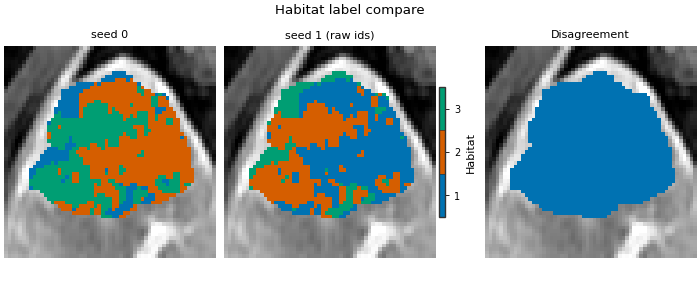
Same centroids, different order: row 1 of seed 0 is row 3 of seed 1. Raw ids therefore disagree on most voxels.
labels_a = np.asarray(map_a.label_array)
labels_b = np.asarray(map_b.label_array)
roi = labels_a > 0
print(f"voxels with the same raw id: {np.mean(labels_a[roi] == labels_b[roi]):.1%}")
voxels with the same raw id: 0.0%
Raw ids side by side
align_labels=False draws both maps as they came out of k-means: the
colours differ although the regions are the same.
Path("out").mkdir(exist_ok=True)
image = subject.image(ROI)
fig = plot_habitat_label_compare(
    image,
    map_a,
    map_b,
    titles=("seed 0", "seed 1 (raw ids)"),
    align_labels=False,
    crop_to="labels",
)
fig.savefig("out/switching_raw_ids.png", dpi=150, bbox_inches="tight")
plt.show()
F:\work\habit_project\habit\viz\habitat_core.py:948: UserWarning: Display geometry conflict: image/anatomy direction does not match mask/label direction. Using the mask/label direction so coronal/sagittal superior-up follows the labelled anatomy. Pass direction= to override.
  resolved_direction, resolved_spacing = resolve_display_geometry(
The overlap table decides the pairing
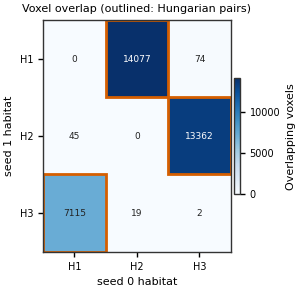
Each cell counts voxels in moving habitat i (seed 1) and reference
habitat j (seed 0). The outlined cells are the Hungarian pairs:
every habitat gets exactly one partner and the outlined total is the
largest possible.
fig = plot_label_overlap_matrix(map_a, map_b, reference_name="seed 0", moving_name="seed 1")
fig.savefig("out/switching_overlap_matrix.png", dpi=150, bbox_inches="tight")
plt.show()
Rename seed 1 into the seed-0 ids
Both runs share a model_id (it digests the spec and subject, not the
random seed), so align_habitat_map() would treat
them as one definition and do nothing. force=True aligns anyway.
print(f"same model_id: {model_a.model_id == model_b.model_id}")
aligned_b = align_habitat_map(map_a, map_b, force=True)
same = np.mean(labels_a[roi] == np.asarray(aligned_b.label_array)[roi])
print(f"voxels with the same id after matching: {same:.1%}")

fig = plot_habitat_label_compare(
    image,
    map_a,
    aligned_b,
    titles=("seed 0", "seed 1 (matched ids)"),
    align_labels=False,
    crop_to="labels",
)
fig.savefig("out/switching_matched_ids.png", dpi=150, bbox_inches="tight")
plt.show()
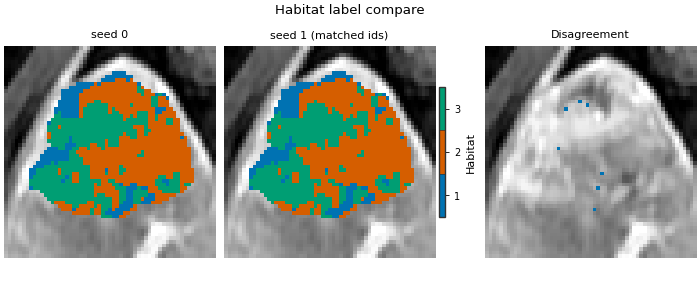
same model_id: True
voxels with the same id after matching: 99.6%
F:\work\habit_project\habit\viz\habitat_core.py:948: UserWarning: Display geometry conflict: image/anatomy direction does not match mask/label direction. Using the mask/label direction so coronal/sagittal superior-up follows the labelled anatomy. Pass direction= to override.
  resolved_direction, resolved_spacing = resolve_display_geometry(
Dice per habitat
habitat_stability() pairs the ids by the same
overlap rule and scores each pair. Pass the original moving map; it
matches internally.
dice = habitat_stability(map_a, [map_b])
print(dice.to_string(index=False))
dice
perturbation  habitat_id  matched_id     dice  n_reference  n_matched
           0           1           3 0.995383         7160       7136
           0           2           1 0.996708        14096      14151
           0           3           2 0.995493        13438      13407
Total running time of the script: (0 minutes 3.507 seconds)