Note
Go to the end to download the full example code.
Applying a saved habitat model
Background. Habitat ids only mean the same thing in two cohorts when both are labelled with the same centroids. Saving the fitted model lets a later or external cohort be labelled with the training definition instead of a new, incomparable fit.
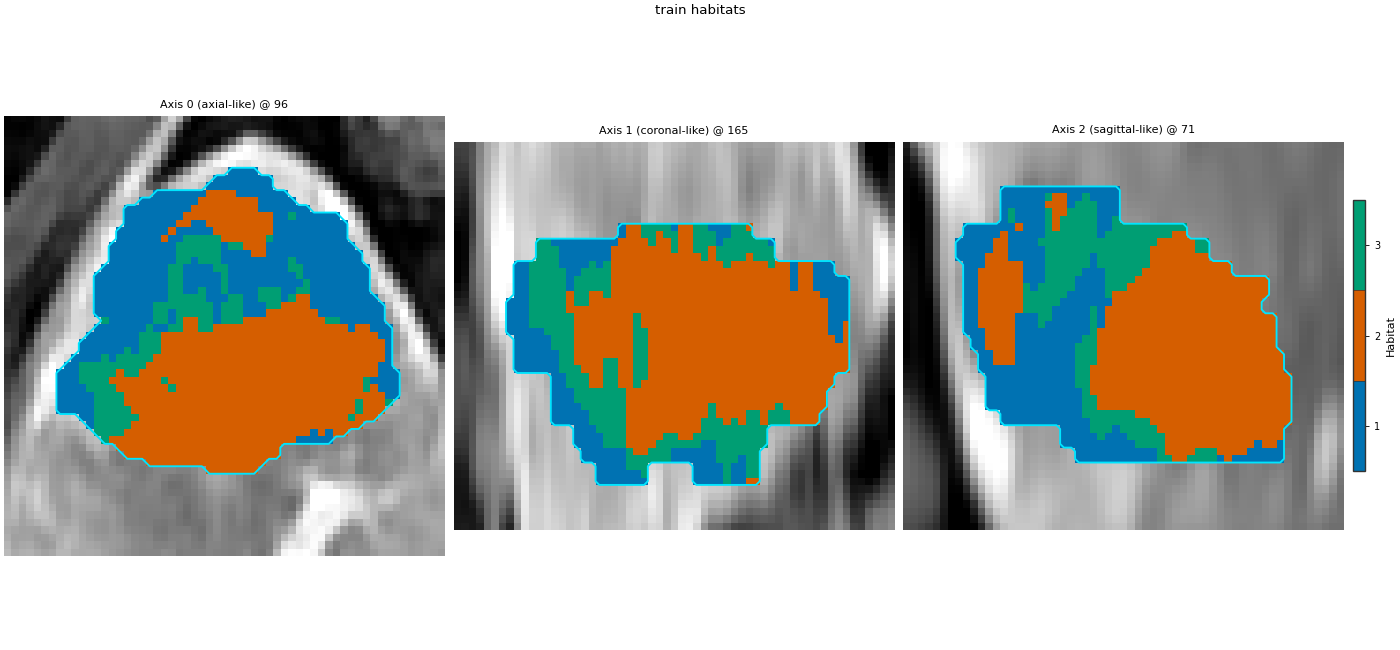
Purpose. You get a .habitatmodel file, the habitat map of a training
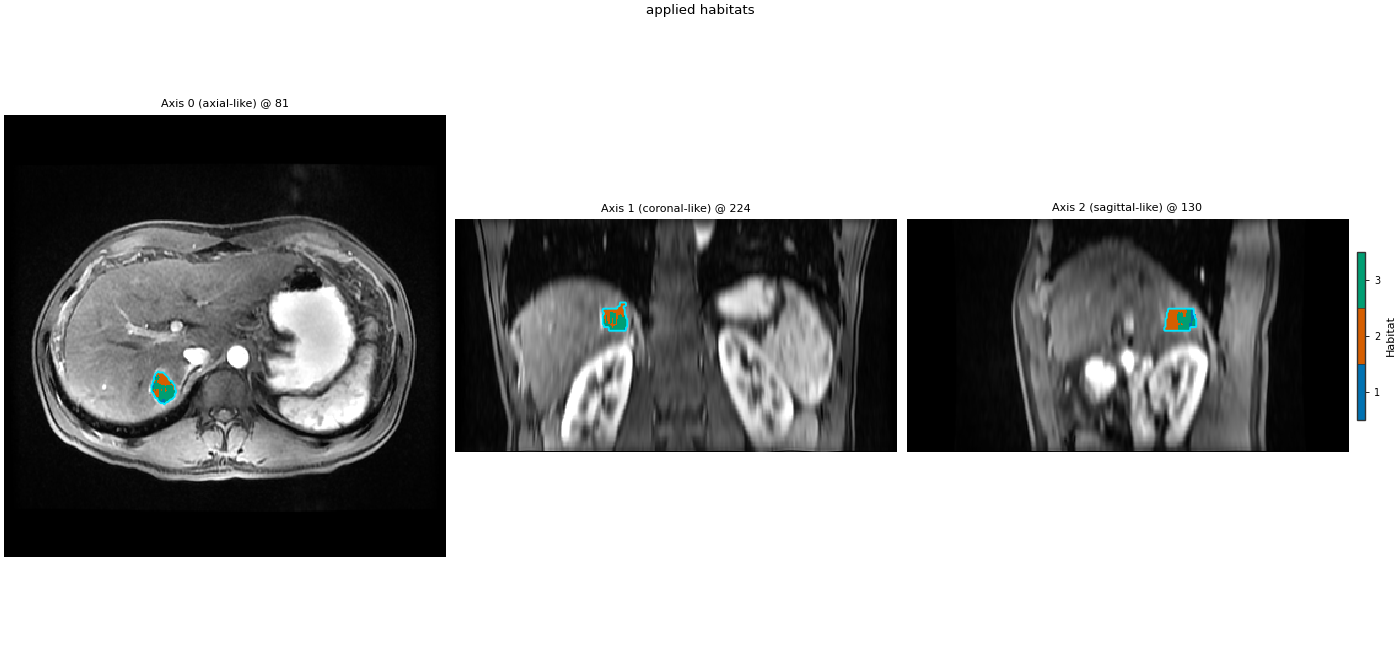
subject, and the habitat map and feature table of two held-out subjects
labelled from the reloaded file.
Key terms.
.habitatmodel – the saved habitat definition (centroids plus the preprocessing state they depend on); loading it labels new subjects without refitting.
fit vs. predict –
fit_predictlearns the centroids and labels the training cohort;predictonly labels subjects with an existing model.
Train a two-step habitat definition, round-trip the
HabitatModel through a .habitatmodel
archive, and project it onto later subjects.
The spec must match between training and application: the model stores cohort-level preprocessing state, but upstream stages are re-declared.
Demo pack has subj001 … subj005. Train on the first three;
apply on the last two.
sphinx_gallery_thumbnail_number = 2
from pathlib import Path

import matplotlib.pyplot as plt

from habit.contracts import HabitatModel, cohort_from_directory
from habit.datasets import fetch_demo
from habit.spec import HabitatSpec, Spec, Stage
from habit.viz import plot_habitat_label_compare, plot_habitat_overlay
import habit.recipes as recipes

DATA = fetch_demo()
# Three DCE phases: unenhanced, arterial, and portal-venous.
MODALITIES = ("pre_contrast", "LAP", "PVP")
ROI = "LAP"
cohort = cohort_from_directory(DATA, modalities=MODALITIES, roi=ROI)
train_cohort = cohort[:3]
new_cohort = cohort[3:5]
print(f"Train: {list(train_cohort.subject_ids)}; apply: {list(new_cohort.subject_ids)}")

spec = HabitatSpec(
    name="habitat_two_step",
    stages=(
        # extract: raw intensities. The stage label can be any unique string.
        Stage("extract_voxel_features", Spec("raw", {"modalities": list(MODALITIES)})),
        # preprocess: per-subject winsorize, then min-max. Statistics are
        # refit on each subject; they are not part of the saved centroids.
        Stage(
            "preprocess1",
            Spec("winsorize", {"winsor_limits": (0.05, 0.05), "across_features": False}),
        ),
        Stage("preprocess2", Spec("minmax", {"across_features": False})),
        # partition + pool + fit: the shared definition that gets saved.
        Stage("partition", Spec("kmeans", {"n_supervoxels": 8, "n_init": 5})),
        Stage("pool", Spec("pool")),
        Stage(
            "fit",
            Spec("kmeans", {"n_habitats": 3, "n_init": 5}),
        ),
        # assign and quantify run again at predict time, using the loaded model.
        Stage("assign", Spec("nearest_centroid")),
        Stage("quantify", Spec("volume")),
        Stage("quantify2", Spec("msi")),
        Stage("quantify3", Spec("ith_score")),
    ),
    random_seed=42,
)
HABIT demo data (cached)
DATA (preprocessed root): C:\Users\dongm\.habit_data\demo-data-v1\preprocessed

On-disk inventory of this folder:
  subjects (5): subj001, subj002, subj003, subj004, subj005
  image series: LAP, PVP, delay_3min, pre_contrast
  mask keys:    LAP, PVP, delay_3min, pre_contrast
  example image: images/subj001/delay_3min/WATER__BH_Ax_LAVA_Flex_3min_Series0012.nrrd
  example mask:  masks/subj001/delay_3min/WATER__BH_Ax_LAVA_Flex_10min_Series0017_mask.nrrd

Your own data must use the same folder tree (change IDs / series names):

  DATA/
    images/<subject_id>/<modality>/<one image file>
    masks/<subject_id>/<roi>/<one mask file>

Then load it with the same call the demos use:

  cohort = cohort_from_directory(DATA, modalities=("LAP",), roi="LAP")

Swap DATA / modalities / roi to match your tree. Mask key is often the
same as one image series (here LAP).
Train: ['subj001', 'subj002', 'subj003']; apply: ['subj004', 'subj005']
Fit on the discovery cohort and persist one self-describing archive.
train_result = recipes.Study(spec=spec).fit_predict(train_cohort)
print(train_result.habitat_model.summary())
print(train_result.features.frame.head())
train_result.features.frame.head()

Path("out").mkdir(exist_ok=True)
archive = Path("out/habitat_model.habitatmodel")
# Versioned, self-describing archive: this file is what you share or keep
# next to a paper, not the Python objects above.
train_result.habitat_model.save(archive)
print(f"Saved {archive}")

fig = plot_habitat_overlay(
    train_cohort[0].image(ROI),
    train_result.habitat_maps[0],
    title="train habitats",
    crop_to="labels",
)
fig.savefig("out/apply_saved_train_overlay.png", dpi=150, bbox_inches="tight")
plt.show()
Cohort.map[_ComputeUnits]:   0%|          | 0/3 [00:00<?, ?it/s]
Cohort.map[_ComputeUnits]:  33%|███▎      | 1/3 [00:01<00:02,  1.20s/it]
Cohort.map[_ComputeUnits]:  67%|██████▋   | 2/3 [00:02<00:01,  1.15s/it]
Cohort.map[_ComputeUnits]: 100%|██████████| 3/3 [00:03<00:00,  1.10s/it]
Cohort.map[_ComputeUnits]: 100%|██████████| 3/3 [00:03<00:00,  1.10s/it]

Cohort.map[_AssignPrecomputedUnits]:   0%|          | 0/3 [00:00<?, ?it/s]
Cohort.map[_AssignPrecomputedUnits]:  33%|███▎      | 1/3 [00:00<00:01,  1.81it/s]
Cohort.map[_AssignPrecomputedUnits]:  67%|██████▋   | 2/3 [00:01<00:00,  1.80it/s]
Cohort.map[_AssignPrecomputedUnits]: 100%|██████████| 3/3 [00:01<00:00,  1.80it/s]
Cohort.map[_AssignPrecomputedUnits]: 100%|██████████| 3/3 [00:01<00:00,  1.80it/s]
HabitatModel kmeans-8a84cd5253eb126f
  habitats           : 3
  features (3)    : pre_contrast, LAP, PVP
  defining cohort    : n=3
  modalities         : pre_contrast, LAP, PVP
  cohort digest      : 7ffce8f589e3ad28...
  produced by        : habitat_model_fitter.kmeans
  habit version      : 3.0.0
  random seed        : 42
  preprocessing state: inertia, validation
   subject  habitat_1_voxel_count  ...    energy  ith_score
0  subj001                14151.0  ...  3.966085   0.964886
1  subj002                 1811.0  ...  2.727729   0.835447
2  subj003                 1834.0  ...  2.402330   0.784911

[3 rows x 30 columns]
Saved out\habitat_model.habitatmodel
F:\work\habit_project\habit\viz\habitat_overlay.py:806: UserWarning: Display geometry conflict: image/anatomy direction does not match mask/label direction. Using the mask/label direction so coronal/sagittal superior-up follows the labelled anatomy. Pass direction= to override.
  resolved_direction, resolved_spacing = resolve_display_geometry(
Reload and label held-out subjects. No fitting after the reload.
model = HabitatModel.load(archive)
# from_model pairs the loaded centroids with the same spec, so the new
# subjects' features are extracted and preprocessed as in training;
# predict still builds each new subject's supervoxels, but assigns them to
# the saved centroids; the habitat model is never refitted.
prediction = recipes.Study.from_model(model, spec).predict(new_cohort)
print(f"Applied to {list(s.subject_id for s in prediction.habitat_maps)}")
print(prediction.features.frame.head())
prediction.features.frame.head()

if prediction.habitat_maps:
    fig_new = plot_habitat_overlay(
        new_cohort[0].image(ROI),
        prediction.habitat_maps[0],
        title="applied habitats",
    )
    fig_new.savefig("out/apply_saved_new_overlay.png", dpi=150, bbox_inches="tight")
    plt.show()
Cohort.map[_LabelAndDescribe]:   0%|          | 0/2 [00:00<?, ?it/s]
Cohort.map[_LabelAndDescribe]:  50%|█████     | 1/2 [00:01<00:01,  1.86s/it]
Cohort.map[_LabelAndDescribe]: 100%|██████████| 2/2 [00:03<00:00,  1.98s/it]
Cohort.map[_LabelAndDescribe]: 100%|██████████| 2/2 [00:03<00:00,  1.98s/it]
Applied to ['subj004', 'subj005']
   subject  habitat_1_voxel_count  ...    energy  ith_score
0  subj004                  889.0  ...  3.489069   0.820012
1  subj005                16354.0  ...  3.548671   0.974884

[2 rows x 30 columns]
F:\work\habit_project\habit\viz\habitat_overlay.py:806: UserWarning: Display geometry conflict: image/anatomy direction does not match mask/label direction. Using the mask/label direction so coronal/sagittal superior-up follows the labelled anatomy. Pass direction= to override.
  resolved_direction, resolved_spacing = resolve_display_geometry(
Total running time of the script: (0 minutes 10.837 seconds)