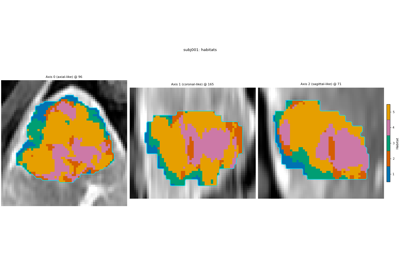
HabitatModel
Note
This page is a reference documentation. It only explains the class signature, and not how to use it. Please refer to the Habitat Guide and Python API guide (v2.0) for usage.
- class HabitatModel(model_id: str, n_habitats: int, feature_names: Tuple[str, ...], centroids: ndarray, preprocessing_state: Mapping[str, Any], spec_payload: Mapping[str, Any], cohort_fingerprint: CohortFingerprint, provenance: Provenance)[source]
Bases:
objectPopulation-level habitat definition – HABIT’s primary scientific artefact.
In v0.1 this was serialised as an opaque
habitat_pipeline.pklbyproduct. Promoting it to a first-class, self-describing object is what enables the strategic goal: a habitat definition published alongside a paper can be loaded by other groups and applied to their own cohorts.- centroids
Population cluster centres, shape
(n_habitats, n_features).- Type:
- preprocessing_state
State learned at fit time and required at apply time, e.g. binning edges and normalisation statistics. Keeping this inside the model is what guarantees train/predict consistency.
- Type:
Mapping[str, Any]
- spec_payload
Serialisable form of the full algorithm specification, so the model can describe itself and be exported back to YAML.
- Type:
Mapping[str, Any]
- cohort_fingerprint
Non-identifiable description of the defining cohort.
- provenance
Software, dependency, and seed fingerprint.
See also
habit.recipes.StudyFits and applies this model.
habit.spec.HabitatSpecAnalysis declaration this model encodes.
habit.contracts.HabitatMapPer-subject label image assigned by this model.
ExamplesModels are produced by the habitat recipes and round-trip through a self-describing
.habitatmodelarchive: >>> from habit.contracts import HabitatModel >>> model = HabitatModel.load(“out/habitat_model.habitatmodel”) # doctest: +SKIP >>> model.n_habitats, model.feature_names # doctest: +SKIP (3, (‘T1’, ‘T2’)) >>> print(model.summary()) # doctest: +SKIP >>> assigner = model.assigner() # doctest: +SKIPSeemeth:habit.recipes.Study.predict (via
Study.from_model) for projecting a reloaded model onto new subjects. Prediction inherits the model’s persistedpostprocess_habitat; an explicit conflicting declaration raisesHABITAPIError.
- summary() str[source]
Return a human-readable model card.
Named
summary(statsmodels convention) rather thandescribe, because in scientific PythonDataFrame.describe()already returns a statistics table, and this returns prose. Intended for both notebook inspection and inclusion in a manuscript’s supplementary material.- Returns:
Multi-line English description of the model.
- with_cohort_preprocessing(state: Mapping[str, Any], spec_payload: Mapping[str, Any]) HabitatModel[source]
Bind the cohort-level feature preprocessing into this model.
A habitat definition is a set of centroids TOGETHER WITH the feature space they live in. Storing the fitted cohort chain here is what lets the model be applied to a new cohort at all: without it, prediction would compute raw features, compare them against centroids fitted on preprocessed features, and return labels that look entirely reasonable.
The model id is recomputed, because two models whose centroids came from differently preprocessed features are different definitions and must not collide. Provenance is derived rather than replaced, so the chain back to each fitting unit stays intact.
- Parameters:
state – Fitted chain state, from
CohortPreprocessingChain.state.spec_payload – The chain’s specification, recorded alongside the fitter’s so the model card states both.
- Returns:
A new model carrying the chain. Callers that need the original still hold it – this contract is frozen.
- assigner(name: str = 'nearest_centroid', **params: Any) Any[source]
Build an assigner that projects this model onto individual subjects.
Assigners take their model at construction time, so this factory is the ordinary way to obtain one and keeps the common case to a single call:
labels = model.assigner()(supervoxel_map). The registry import is lazy: the contracts layer must stay importable without the domain layer.- Parameters:
name – Registered
habitat_assignerimplementation name.**params – Parameters for that implementation.
- Returns:
A one-argument callable from a supervoxel map to a habitat map.
- save(path: str | Path) Path[source]
Persist the model in a versioned, self-describing format.
Deliberately not a bare pickle: a shared scientific artefact must remain readable across HABIT versions, or fail with an explicit incompatibility message rather than a deserialisation error. The
.habitatmodelfile is a ZIP archive holding a JSON manifest (format name, format version, producing HABIT version, and every scalar field) plus the centroid matrix as a.npymember.- Parameters:
path – Destination file path.
- Returns:
The written path.
- classmethod load(path: str | Path) HabitatModel[source]
Load a model previously written by
save().- Parameters:
path – Source file path.
- Returns:
The reconstructed model.
- Raises:
CompatibilityError – If the file was produced by an incompatible format or HABIT version, with guidance on which version can read it.