align_habitat_map
Note
This page is a reference documentation. It only explains the function signature, and not how to use it. Please refer to the Habitat Guide and Python API guide (v2.0) for usage.
- align_habitat_map(reference: HabitatMap, moving: HabitatMap, *, force: bool = False) HabitatMap[source]
Remap
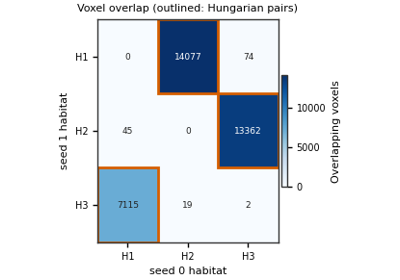
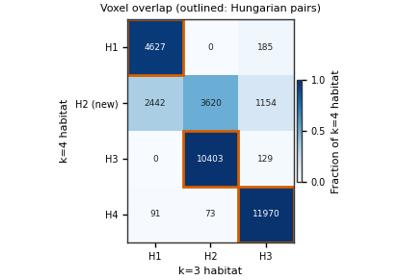
movinghabitat ids onto thereferenceid space.For two maps of the same voxels (retest, perturbation, another preprocessing chain, another reader): independently clustered maps permute integer ids, so ids are paired by maximal voxel overlap (Hungarian on the overlap counts, the Prior 2024
munkresstep) andmovingis rewritten into the reference ids. Maps that already share amodel_id(the apply-saved-model path) are returned unchanged: those ids are already the same definition.To name habitats of different subjects use
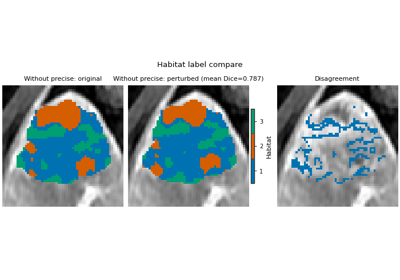
align_habitat_maps_to_prototypes(); overlap between two patients’ voxels has no meaning.habitat_stability()uses the same pairing, so the compare figure and the Dice table share one correspondence. Do not feed an already-aligned map back intohabitat_stability; it pairs the original maps itself.- Parameters:
reference – Habitat map whose ids are the target space.
moving – Independently labelled map of the same voxel grid.
force – If True, align even when
model_idalready matches. Independentone_step/fit_predictruns on the same subject share a model_id (spec + subject-id digest, not image content) and needforce=True.
- Returns:
A new map with remapped labels.
model_idis taken fromreference.habitat_idsstarts with the reference ids and appends leftover moving habitats (rewritten to unused ids aftermax(reference ids)) when the moving map had more clusters. The inputmovingmap is returned as-is when the model ids already match andforceis False.- Raises:
HABITAPIError – If the grids differ.