6. Matching Habitat Labels
Background. A clustering run numbers its habitats in arbitrary order, so the same tissue can be habitat 1 in one run or patient and habitat 3 in another (label switching). Purpose. These pages show how HABIT matches the ids so that Dice, volume fractions and cohort tables compare like with like.
Calling it on a fitted study: Matching habitat labels across subjects. The pages below show why ids switch and how each matcher works.
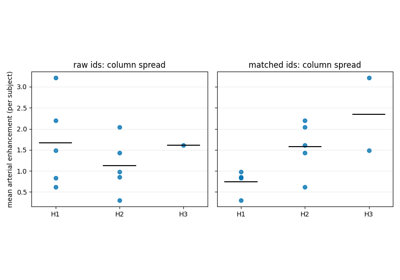
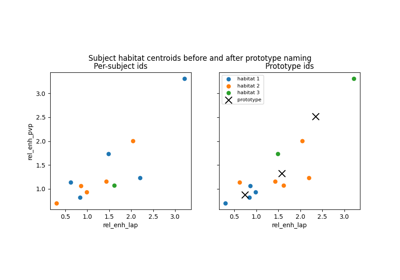
Habitat ids from independent clusterings are arbitrary: habitat 1 of one fit can be habitat 3 of another. Anything that compares habitats by id (Dice, volume fractions, a cohort feature table) must match the ids first. HABIT has two matchers, chosen by what the two sides share:
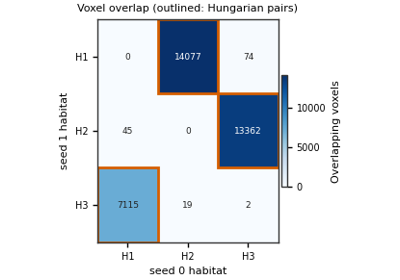
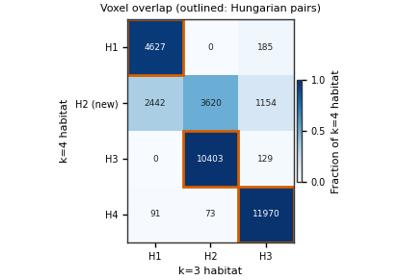
Voxel overlap – the maps label the same voxels (a restart, another
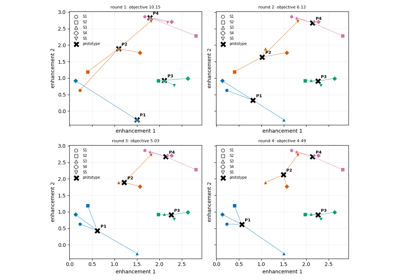
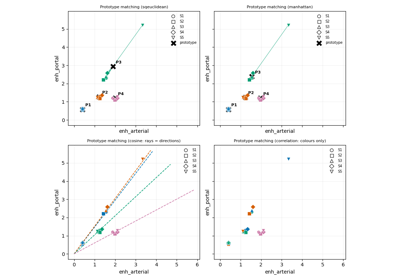
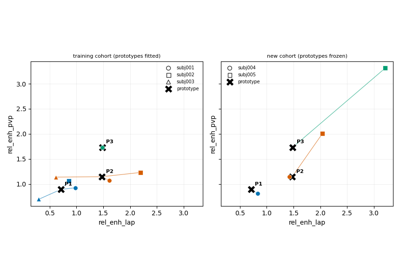
k, another feature set, a perturbed image, a second reader). Hungarian assignment on the voxel-overlap table.align_habitat_map(),habitat_stability().Shared prototypes – the maps label different subjects. Each subject’s habitat summaries are matched one-to-one onto
Kshared prototypes, iterated until stable; prototypes can be frozen to name a new cohort.align_habitat_maps_to_prototypes().
A shared cohort model (two-step, direct pooling, an applied saved model) already uses one id space and needs neither. Formulas, proofs, and literature: Matching habitat labels across fits and subjects.