Note
Go to the end to download the full example code.
Load from NIfTI files
Background. Images and masks often sit as loose files (NIfTI, NRRD, MetaImage) rather than in the HABIT folder layout. HABIT can point at each file directly and reads the voxels only when a stage needs them.
Purpose. You get a geometry report that says whether image and mask
grids agree, a Cohort built from file paths, and
a figure of the loaded pair.
When to use. Use this when your files are scattered or named freely;
you choose the series and ROI names yourself. The demo pack happens to use
.nrrd; .nii / .nii.gz work the same way.
Key terms.
cohort / subject / ROI – see Load from directory.
geometry check – compares shape, spacing, origin and direction of image and mask;
validate_geometryonly reports, it changes nothing.
Point at one image file and one mask file (.nii, .nii.gz, .nrrd,
.mha, .mhd). Change the paths below to your own files. One person
and several people are each a Cohort.
One person. role_name is the series or ROI name stored on the volume.
Use the same string as the dictionary key.
from pathlib import Path

import matplotlib.pyplot as plt

from habit.adapters import FileImageRef
from habit.contracts import Cohort, Subject
from habit.datasets import fetch_demo
from habit.image import (
    GeometryPolicy,
    ImageMaskPair,
    align_image_mask,
    read_image,
    read_mask,
    validate_geometry,
)
from habit.viz import plot_nifti_ingest

DATA = fetch_demo()
# Change these two paths to your files.
IMAGE = DATA / "images" / "subj001" / "LAP" / "WATER__WATER__Ax_Dyn_LAVA_Flex+C_Series0009.nrrd"
MASK = DATA / "masks" / "subj001" / "LAP" / "WATER__BH_Ax_LAVA_Flex_10min_Series0017_mask.nrrd"

image = read_image(IMAGE, modality="LAP")
mask = read_mask(MASK)
# Report-only check: lists which of shape / spacing / origin / direction differ.
report = validate_geometry(image, mask)
print(report.compatible, report.mismatches)
if report.compatible:
    pair = ImageMaskPair(image, mask, report)
else:
    # Explicit fix only when grids differ: resample the mask onto the image grid.
    pair = align_image_mask(
        ImageMaskPair(image, mask),
        policy=GeometryPolicy.RESAMPLE_MASK,
    )
print(pair.image.data.shape, pair.mask.data.shape)

# FileImageRef stores only the path; voxels are read when a stage needs them,
# so large cohorts stay light in memory.
subject = Subject(
    subject_id="subj001",
    images={"LAP": FileImageRef(IMAGE, is_mask=False, role_name="LAP")},
    masks={"LAP": FileImageRef(MASK, is_mask=True, role_name="LAP")},
)
one = Cohort([subject], name="one")
print(one)

volume = subject.image("LAP")
roi = subject.mask("LAP")
HABIT demo data (cached)
DATA (preprocessed root): C:\Users\dongm\.habit_data\demo-data-v1\preprocessed

On-disk inventory of this folder:
  subjects (5): subj001, subj002, subj003, subj004, subj005
  image series: LAP, PVP, delay_3min, pre_contrast
  mask keys:    LAP, PVP, delay_3min, pre_contrast
  example image: images/subj001/delay_3min/WATER__BH_Ax_LAVA_Flex_3min_Series0012.nrrd
  example mask:  masks/subj001/delay_3min/WATER__BH_Ax_LAVA_Flex_10min_Series0017_mask.nrrd

Your own data must use the same folder tree (change IDs / series names):

  DATA/
    images/<subject_id>/<modality>/<one image file>
    masks/<subject_id>/<roi>/<one mask file>

Then load it with the same call the demos use:

  cohort = cohort_from_directory(DATA, modalities=("LAP",), roi="LAP")

Swap DATA / modalities / roi to match your tree. Mask key is often the
same as one image series (here LAP).
False ('origin', 'direction')
(200, 360, 360) (200, 360, 360)
Cohort(1 subjects [subj001], name='one')
Visual summary of this route: the image/mask file pair becomes a plottable
Subject (right panel zooms to the ROI). Pass the
ImageVolume (not .data).
Path("out").mkdir(exist_ok=True)
fig = plot_nifti_ingest(volume, roi)
fig.savefig("out/data_from_nifti_ingest.png", dpi=150, bbox_inches="tight")
plt.show()
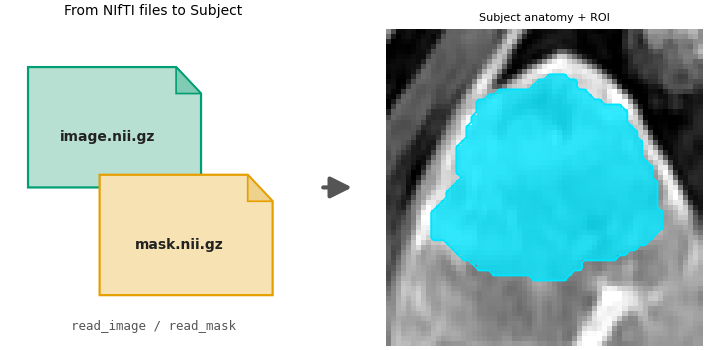
F:\work\habit_project\habit\viz\diagrams.py:245: UserWarning: Display geometry conflict: image/anatomy direction does not match mask/label direction. Using the mask/label direction so coronal/sagittal superior-up follows the labelled anatomy. Pass direction= to override.
  resolved_direction, resolved_spacing = resolve_display_geometry(
Several people. One Subject per person, then one
cohort. subject_id values must be unique. Pass many to
fit_predict, not a list.
IMAGE_2 = DATA / "images" / "subj002" / "LAP" / "012_WATERWATERAxDynLAVAFlexC.nrrd"
MASK_2 = DATA / "masks" / "subj002" / "LAP" / "016_WATERWATERBHAxLAVAFlex5min_mask.nrrd"
subject_2 = Subject(
    subject_id="subj002",
    images={"LAP": FileImageRef(IMAGE_2, is_mask=False, role_name="LAP")},
    masks={"LAP": FileImageRef(MASK_2, is_mask=True, role_name="LAP")},
)
many = Cohort([subject, subject_2], name="many")
print(many)
Cohort(2 subjects [subj001, subj002], name='many')
Total running time of the script: (0 minutes 1.623 seconds)