SubjectPipeline
Note
This page is a reference documentation. It only explains the class signature, and not how to use it. Please refer to the Habitat Guide and Python API guide (v2.0) for usage.
- class SubjectPipeline(voxel_feature_extractor: VoxelFeatureExtractor, supervoxelizer: Supervoxelizer | None, habitat_assigner: HabitatAssigner | None, supervoxel_feature_extractor: SupervoxelFeatureExtractor | None = None, voxel_feature_preprocessor: SubjectFeaturePreprocessor | None = None, supervoxel_feature_preprocessor: SubjectFeaturePreprocessor | None = None, cohort_feature_preprocessor: CohortFeaturePreprocessor | None = None, on_geometry_mismatch: str = 'resample_mask', postprocess_supervoxel: ConnectedComponentPostprocess | None = None, postprocess_habitat: ConnectedComponentPostprocess | None = None, observer: StepObserver | None = None)[source]
Bases:
objectThe subject-level chain composed into a single callable.
HABIT’s answer to
monai.transforms.Compose. A genericComposecannot be reused directly because HABIT’s steps are heterogeneously typed –Subject -> VoxelFeatureField -> Supervoxelization -> HabitatMap– and erasing those types would discard exactly the contracts that make the design checkable.A fitted
HabitatModelplus aSubjectPipelineis precisely the pair a study publishes for external validation: the definition, and the procedure that applies it.- Parameters:
voxel_feature_extractor – Step producing per-voxel features.
supervoxelizer – Step producing supervoxels.
Noneclusters voxels directly, which is what the one-step and direct-pooling designs do.habitat_assigner – Step assigning habitat labels, already bound to a fitted model.
Nonebuilds a FIT-TIME pipeline:units()works,__call__()does not. Cohort-level fitting needs exactly that, and sharing this class rather than reimplementing the stages is what guarantees a model is applied to units produced the same way it was fitted on.supervoxel_feature_extractor – Optional step describing the supervoxels.
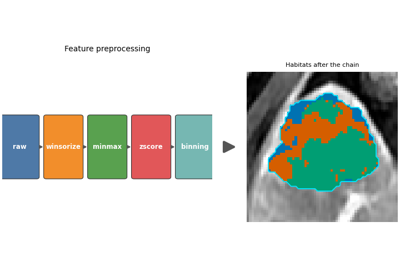
Nonekeeps the feature means the supervoxelizer attached, which is the v0.1 default; asupervoxel_radiomicsextractor replaces them with texture features. Ignored whensupervoxelizerisNone, since a single voxel has no region to describe – mirroring v0.1, where the one-step design ignores thesupervoxel_levelblock.voxel_feature_preprocessor – Optional stateless preprocessing of the voxel features, applied BEFORE supervoxelisation. This is v0.1’s
preprocessing_for_subject_level, and its position matters: normalising each subject before its ROI is partitioned is what keeps supervoxel boundaries from tracking scanner intensity scale.supervoxel_feature_preprocessor – Optional stateless preprocessing of the supervoxel features. The slot v0.1 lacked entirely – per supervoxel radiomics had no way to be normalised within a subject before cohort pooling. Requires a supervoxelizer, for the same reason as
supervoxel_feature_extractor.cohort_feature_preprocessor – Optional FITTED cohort-level chain, applied last, immediately before assignment. Required whenever the habitat model was fitted on cohort-preprocessed units: omitting it would feed the assigner a feature space different from the one the model was defined in, and it would still return plausible-looking labels.
on_geometry_mismatch – How to handle image/mask grid disagreements before Stage-1.
"resample_mask"(default) nearest-neighbour resamples each ROI onto the first image modality;"strict"raisesGeometryError.postprocess_supervoxel – Optional connected-component cleanup applied immediately after supervoxelization and before supervoxel feature extraction. Ignored when
supervoxelizerisNone.postprocess_habitat – Optional connected-component cleanup applied immediately after habitat assignment and before habitat features.
observer – Optional step observer for debugging / QA. Never part of
specor fingerprints;None(default) is zero-cost.
- __init__(voxel_feature_extractor: VoxelFeatureExtractor, supervoxelizer: Supervoxelizer | None, habitat_assigner: HabitatAssigner | None, supervoxel_feature_extractor: SupervoxelFeatureExtractor | None = None, voxel_feature_preprocessor: SubjectFeaturePreprocessor | None = None, supervoxel_feature_preprocessor: SubjectFeaturePreprocessor | None = None, cohort_feature_preprocessor: CohortFeaturePreprocessor | None = None, on_geometry_mismatch: str = 'resample_mask', postprocess_supervoxel: ConnectedComponentPostprocess | None = None, postprocess_habitat: ConnectedComponentPostprocess | None = None, observer: StepObserver | None = None) None[source]
- units(subject: Subject) Supervoxelization[source]
Run every stage up to (but excluding) habitat assignment.
Exposed separately because cohort-level fitting needs exactly this: the clustering units of each training subject, pooled and then used to DEFINE the habitats. Sharing one implementation with
__call__()is what guarantees a model is applied to units produced the same way they were fitted on.- Parameters:
subject – The subject to process.
- Returns:
The subject’s clustering units. Every ROI voxel is its own unit when no supervoxelizer is configured.
- assign(units: Supervoxelization) Tuple[HabitatMap, Supervoxelization][source]
Assign habitats from clustering units already produced by
units().This is the train-path reuse hook: cohort-level fit recipes and sklearn adapters compute Stage-1 units once, then call this instead of
__call__()(which would re-extract voxel / supervoxel features). Predict / apply paths keep calling__call__()so held-out subjects are still derived from images.- Parameters:
units – Precomputed clustering units for one subject (before cohort-level preprocessing).
- Returns:
(habitat_map, units_after_cohort_prep). The post-prep units feed the v0.1habitats.parquetunit table at the writer.- Raises:
HABITAPIError – If this is a fit-time pipeline (no assigner).
- __call__(subject: Subject) HabitatMap[source]
Run voxel features, supervoxelisation and assignment for one subject.
- Parameters:
subject – The subject to label.
- Returns:
The subject’s habitat label image.
- Raises:
HABITAPIError – If this is a fit-time pipeline (no assigner).
- label_and_describe(subject: Subject, units: Supervoxelization, extractors: Sequence[HabitatFeatureExtractor]) Tuple[HabitatMap, FeatureTable | None, Supervoxelization][source]
Assign habitats from precomputed units, then extract habitat features.
- Parameters:
subject – Subject providing images for habitat-level descriptors.
units – Clustering units from an earlier Stage-1 pass.
extractors – Habitat feature families; may be empty when only the label map is needed.
- Returns:
(habitat_map, feature_table_or_none, units_after_cohort_prep).
- extract_features(subject: Subject, extractors: Sequence[HabitatFeatureExtractor]) FeatureTable[source]
Run the pipeline and then the requested habitat feature families.
Named
extract_features(an action) rather than the bare nounfeatures, which would read as an attribute on a callable object. Recomputes Stage-1 fromsubject(predict-path semantics). When units are already in memory, calllabel_and_describe()instead.- Parameters:
subject – The subject to process.
extractors – Habitat feature families to compute.
- Returns:
One feature table for that subject, joined across families.
- Raises:
HABITAPIError – If
extractorsis empty.