SupervoxelRadiomicsFeatures
Note
This page is a reference documentation. It only explains the class signature, and not how to use it. Please refer to the Habitat Guide and Python API guide (v2.0) for usage.
- class SupervoxelRadiomicsFeatures(modality: str | None = None, modalities: Sequence[str] = (), as_: str | None = None, params_file: str | None = None, params: Dict[str, Any] | None = None, supervoxel_batch: int = 64, supervoxel_union_bbox_crop: bool = True, supervoxel_pad_distance: int | None = None, use_supervoxel_cext: str | bool = True, union_bin: bool = False, use_torch_radiomics: str | bool = 'auto', torch_device: str = 'auto', torch_dtype: str = 'float64', output_float32: bool = True)[source]
Bases:
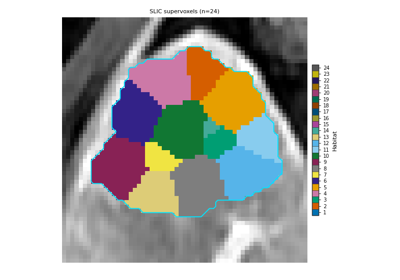
objectDescribe each supervoxel by PyRadiomics features of the original images.
One extraction pass runs per modality and the resulting columns are suffixed with
-{modality}, which is the v0.1 column scheme forconcat(supervoxel_radiomics(m1), supervoxel_radiomics(m2)). All modalities of a subject are used when none are named.The single-modality form
modality="T1"is the tree-friendly alternative tomodalities=["T1"];as_renames the column suffix so the same modality can be extracted under two parameter sets without a name clash.- Parameters:
modality – Single modality name; mutually exclusive with
modalities.modalities – Modality names to extract from; empty selects all the subject carries.
as – Alias used as the column suffix instead of the modality name; requires
modality.params_file – Path to a PyRadiomics parameter YAML, or
Nonefor PyRadiomics defaults.params – Inline PyRadiomics settings mapping, for API users holding settings in memory. Mutually exclusive with
params_file.supervoxel_batch – Labels processed per batch. Larger batches trade memory for speed and never change the numbers.
supervoxel_union_bbox_crop – Crop image and masks to the bounding box of the union of all supervoxels before extraction.
supervoxel_pad_distance – Padding around that bounding box;
Nonekeeps the PyRadiomicspadDistancesetting.use_supervoxel_cext –
True(default),"auto", orFalse– whether to use the habit native C extension for texture matrices.union_bin – When False (default) each supervoxel is discretized with its own
binWidthedges, matching PyRadiomicsexecute(). When True, all labels share one union-mask bin.use_torch_radiomics –
"auto",TrueorFalse– whether to use the TorchRadiomics GPU path when torch and CUDA are present.torch_device – Torch device string, or
"auto"to select one.torch_dtype –
"float64"(default) or"float32"for the torch path.output_float32 – Downcast the resulting feature columns to float32, the v0.1 default that keeps large supervoxel tables manageable.
- __init__(modality: str | None = None, modalities: Sequence[str] = (), as_: str | None = None, params_file: str | None = None, params: Dict[str, Any] | None = None, supervoxel_batch: int = 64, supervoxel_union_bbox_crop: bool = True, supervoxel_pad_distance: int | None = None, use_supervoxel_cext: str | bool = True, union_bin: bool = False, use_torch_radiomics: str | bool = 'auto', torch_device: str = 'auto', torch_dtype: str = 'float64', output_float32: bool = True) None[source]
- __call__(subject: Subject, partition: Supervoxelization) Supervoxelization[source]
Compute per-supervoxel radiomics for one subject.
- Parameters:
subject – Subject supplying the original intensity images.
partition – The subject’s supervoxel partition.
- Returns:
The partition carrying one radiomics feature vector per supervoxel, across every requested modality.
- Raises:
HABITAPIError – If a requested modality is absent or the partition holds no supervoxel.