EachHabitatRadiomicsFeatures
Note
This page is a reference documentation. It only explains the class signature, and not how to use it. Please refer to the Habitat Guide and Python API guide (v2.0) for usage.
- class EachHabitatRadiomicsFeatures(params_file: str | None = None, params: Dict[str, Any] | None = None, modalities: Sequence[str] | None = None, modality: str | None = None, as_: str | None = None, use_torch_radiomics: str | bool = False, torch_device: str = 'auto', torch_dtype: str = 'float64')[source]
Bases:
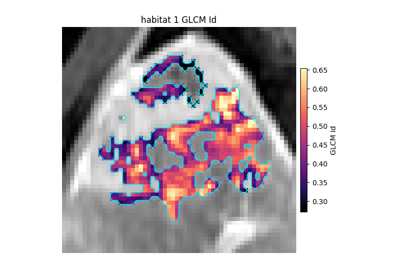
objectPyRadiomics features of the raw image(s) within each habitat label.
This is the v1 form of the v0.1
each_habitatfeature type: for every habitat id the model can assign, PyRadiomics runs on each raw modality with the multi-label habitat map as mask and the habitat id as label, replicatingHabitatRadiomicsExtractor.extract_radiomics_features_from_each_habitat(mask-metadata harmonisation included).Where v0.1 wrote one CSV per habitat plus a
habitat_count.csv, the v1 single-row table carries everything at once:has_habitat_{id}– 1.0 when the habitat is present in this subject, else 0.0 (the v0.1 habitat-count semantics);habitat_{id}_{feature}_of_{modality}– one column per PyRadiomics feature,NaNwhen the habitat is absent (NaNis the honest “not measured”; zero would be a fabricated measurement).
Columns and their order are canonical for a given extractor configuration – every subject of the same model yields the same layout regardless of which habitats it contains. A subject whose map has no habitat label at all yields only the
has_habitat_*columns.Extraction is one multi-label pass per modality (union-bbox crop, then per-habitat
_applyBinning+ native C matrices).binWidthgray levels stay per-habitat, matchingexecute(label=id). Torch is off unless the caller setsuse_torch_radiomics.- __init__(params_file: str | None = None, params: Dict[str, Any] | None = None, modalities: Sequence[str] | None = None, modality: str | None = None, as_: str | None = None, use_torch_radiomics: str | bool = False, torch_device: str = 'auto', torch_dtype: str = 'float64') None[source]
- __call__(subject: Subject, habitat_map: HabitatMap) FeatureTable[source]
Compute the per-habitat radiomics family for one subject.
- Parameters:
subject – Owning subject; every selected modality is extracted.
habitat_map – Habitat labels; used as the multi-label mask.
- Returns:
One-row table of per-habitat radiomics plus presence indicators.